Saturday, November 22, 2014
Spirit--The 7th Fire of Alaska
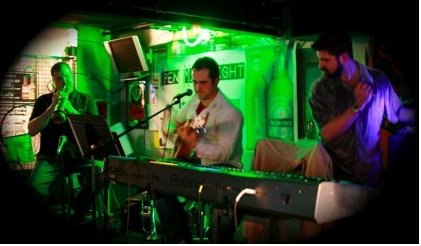
Rod Master (seated) engineered and played on my CD Cruisin' Anchorage, is working on his next project Spirit -- The Seventh Fire of Alaska, for its production scheduled for February 20, 2015 at Anchorage's Discovery Theater. I guess another old gig partner -- Matt Hammer -- will be returning to Alaska to see the production. Rod has worked with Native musical groups for years.
Tuesday, March 11, 2014
Monday, March 10, 2014
Some of my recordings on sax (and maybe a reading or two)
Bridget Sullivan vocal on Shadows and the Light; Instrumental Cool Joe
Froma live reading at the Out North Theater in Anchorage Genesis on a Book Shelf ;
Froma live reading at the Out North Theater in Anchorage Genesis on a Book Shelf ;
Sunday, March 9, 2014
http://www.alaskadispatch.com/article/20140318/how-exxon-valdez-spill-gave-birth-modern-oil-spill-prevention-plans
I remember the event well and dedicated a long chapter in my book Fire and Ice to the event and the players in one of the largest oil spills recorded.
Saturday, February 22, 2014
SCIENCE AND GLOBAL W er F um STUFF
My son, Tim, called me yesterday on my birthday and before
long we were chatting philosophical stuff. He asked me if I planned on posting
any more things like I did about Darwin. So, we talked about science and
technology a bit and I came up with this:
Science toys with us, as though within it, we will
eventually discover the Holy Grail. Always, since even before Francis Bacon, we
believed that because science might provide for us enough food and water access
to feed the planet and provide for everyone, or through it, we would be able to
talk to one another in a common language, see our common humanity, science would
eventually eradicate war. Science didn’t eradicate war, it perfected it. In the
twentieth century, wars were first fought with total scientific detachment. Open a trap door, press a button and vaporize
a quarter of a million people. Those who
would place their faith primarily in science and would turn a deaf ear to the
dualist/theists will regret the lessons learned from the past. Remember the difference
between “knowledge” and “wisdom”. It takes knowledge to build the “big one”, but
“wisdom” to keep that sonofabitch away from the kids.
Is science finally “settled”? Is it settled regarding global
warming or ape-to-man evolution (see my Darwin posting)? Arising out of the
first agricultural civilizations appearing after the close of the last ice age,
man’s intellectual hunger has no limit and its capacity has no end. It often gambles on the attempt to observe
some discernible pattern in the events of history. Well, how about this musing
of Loren Eiseley in his 1971 Invisible Pyramid: “Beginning on some winter night, the snow will fall steadily
for a thousand years and hush in it’s fallings … the cities. The delicate
traceries of the frost will slowly dim the glass in the observatories and all
will be as it had been before … The long trail of Halley’s comet, once more
returning, will pass like a ghostly matchflame over the unwatched grave of the
cities.”? Will Chicago be one huge block
of ice, and in it, the forlorn and echo-empty “Carbon Exchange”? Don’t ask me.
I don’t attempt answers, I just post questions. It’s much safer. But I will
say, “It’s not… ‘settled’”. Look, if the
Vikings who about 1,000 A.D. traveled from Norway to Greenland (so named
because it was lush in the hospitable balmy climate), then on to Newfoundland
where they luxuriated and built settlements which they occupied for about 500
years, decided to “bag it”, and go back home, it wasn’t because of a minor nip
in the air. Fur-wrapped Vikings could deal with a little chill. That mini ice
age was punishing. If the crops won’t grow and the fishing spots are frozen
over, it’s time to bag it. Another indicator can be found in the woods where
the wood for Stradivarius violins were initially taken. That quality of wood
has disappeared because the changing climate has made the tree growing season so
radically different. So, if Nero is going to play the fiddle while we freeze,
it won’t be a “Strad”. However, if we
really warm up, you won’t hear any complaints from me. I’m already in Alaska. So,
you’ll find me eating locally-grown bananas on the beach in Nome. More stuff
later… I’m getting tired of writing.
Monday, February 3, 2014
Passing of a life-long Alaska at age 93
My mother-in-law, Ida deVille, at
age 94 passed away last night at 11:30. She went to join her husband, Jacques
(“Jack”) who died at age 91 in 2003. The life-long Alaskans, before moving to
Cordova, resided in the now-abandoned town of Katalla which rested on the very
edge of the Gulf of Alaska near Kayak Island. Following is my favorite story
about Ida:
Jack – not surprising – had been a commercial fisherman most of his life. Ida accompanied him on the boat quite often during the fishing season, but not this one time. She stayed home to take care of their three sons; this was before the births—later—of two daughters.
In the mid ‘40’s, Jack deVille had been gone for some time chugging his way around the Sound in search of salmon and had no way of knowing that wife, Ida, had been worrying over the deteriorating condition of their youngest --infant -- son, Bob. Katalla had no hospital, doctors or even radio communications to summon help from Cordova. The trip from Katalla to Cordova by boat – assuming weather was conducive to the trip – was tedious, and very long. And without radar, piloting a boat in the dark when approaching the waters off the Copper River delta with its sandbars and breakers, would have to be a matter of life or death.
On such emergency occasions, the powerful radio at the St. Elias lighthouse on Kayak Island had contacted Cordova for help. There were times when this was difficult to arrange. When the weather was bad, a boat from Katalla could not approach the beach line of Kayak Island without being smashed on the rocks. But Ida was becoming desperate. At the kitchen table, she scribbled four notes which read, “Someone sick. Need Plane”. She folded each paper and stuffed them into four tobacco cans. She sealed the cans with wax and tape. Leaving her sons in the charge of a couple of teenage neighbor girls, she trekked out into the stormy weather and climbed into a neighbor’s boat who then maneuvered it into the deeper water and turned south-southeast. The engine, the reliable “two-bits” “two-bits” “two-bits” sound it made as it dutifully pushed the boat into the bigger and bigger swells, Ida and the neighbor squinted out of the pilot house windows, their eyes fixed on the rotating light of the lighthouse off in the distant darkness.
Reaching the south end of the island they “paced” back and forth directing the beams of spotlights at the lighthouse living quarters until they saw dark figures immerging from the building, who, with flashlights in hands, made their way to the beach. The spotlight on the boat was now directed on to Ida, on deck, so the Coast Guardsmen could see she was holding up a can. She then flung it into the water. Then she did the same with the other three cans. Now it was time to wait for the waves to carry the cans to the beach. The Coasties could be seen walking up and down the beach, scanning their flashlight beams on the incoming waves. After a period of time, one of them began waving, and the spotlight revealed that he held up one of the tobacco cans.
The next morning the small plane arrived. It was so small that Ida could only pack for Bob, no clothes for herself. She asked the two Hanson girls what they would like from Cordova as payment for watching the boys. “Ice skates” they replied. In the Cordova hospital, Bob was diagnosed with bronchial pneumonia. He was in the hospital for two months. During that time, Jack had pulled into Cordova and then learned about the situation. After Bob’s release from the hospital, Jack, Ida and Bob boarded their Boat, the “New Josie” and he loaded his new prized possession – his new Ford truck – onto the stern of the boat, lashed it down, and headed for Katalla.
In the Gulf, in line with the Copper River Delta, the winds tore through the area with such force that crossing was impossible. In fact, turning the vessel around in those swells took timing, nerve, and luck to minimize the time spent sideways to the swells. He was lucky enough to swing the “New Josie” around to prevent capsizing, but not lucky enough to save his Ford, which was ripped loose of it’s lashings and washed overboard. That was only the first of many attempts to cross the Gulf during the next 3 months.
When they finally moored up in Katalla, 5 months after leaving, Ida was very apologetic to the Hanson girls and gave them a pair of clip-on ice skates, adjustable in size, so they could share them.
Recently acquired photo of Ida in the ‘20’s at the Woody
Island Baptist Mission near Kodiak Alaska where she spent her younger days.
Bottom picture Ida is seated making bread in the kitchen of the mission. Upper left, showing off her purchases from her first paycheck: a Bible, a sled, and her new boots. Upper right, still making bread
decades later.

Monday, December 2, 2013
David Jensen hired me to play at his book signing Friday, 5 - 7 pm. Blue Hollomon Art Gallery. 355 Arctic blvd
And ... I've been asked to open for--and play with Forget-Me-Not band January 11th, starts 7 pm, for the Old Russian News Years celebration at the Anchorage Activity Center. See you all there. Update: Leo Grinberg (in the white shirt, right-hand column), also a Russian from Magagdan, will be coming, too. I played back-up during his concert a while back and put that piece "I Will Love You More Than You'll Ever Know" on my CD
Friday, November 22, 2013
Saturday, November 16, 2013

Thursday, November 14, 2013
Back at Kaladi's (on the Muldoon curve) tomorrow at 6:00
In addition, I'll be playing at the annual craft's weekend at the Anchorage museum, December 1st, 1:30 - 3:30. I hope to see you there.
Thursday, November 7, 2013
Playing this week-end
I'LL BE AT KALADI'S ON THE MULDOON CURVE 6-8 PM TOMORROW. AND SUNDAY AT THE BIG MATT HAMMER JAM AT THE TAP ROOT STARTING 6 PM. SEE YOU THERE!
Friday, August 23, 2013
Happy belated birthday little Chucky Darwin .. But you're still full of shit
When I first started this blog, it was to inform friends of what I was up to, scheduled gigs and training I was conducting. By the way, I will by playing on the JBER military base here on September 11th for their Survivor Outreach event. Anyway, I thought I'd insert an essay from time to time because I don't know what else to do with them. So, here is one which is an off-shoot of the one I sent to Ben Stein's site which you can find at the very bottom of this blog. This is a further clarification of Darwin's one-time buddy who later denied the possibility of Darwinism, or Natural Selection. Here it is:
The motive behind this piece isn't a defense of Genesis,
it's a "back atcha" to the arrogance of the likes of Richard Dawkins or
professional smart-ass bill Maher. Let THEM cough and sputter and be defensive
for a change. I understand how natural selection works and that its principle
was demonstrated by the introduction of the English sparrow to the US in the
early 1800's. They flourished and really spread. Now you can see that those that
headed north and their decedents are portly for insulation against the chill
while those that went south are now spindly like the African bushman. However,
the ones that migrated north did not start growing fur and earmuffs. Anyway,
like I wrote in the foreword of my book "Lazarus", C. S. Lewis noticed
an arrogant tone of authority in the scientific and technological community
that is undeserved and grating.
“Natural Selection” is the process that caused man to evolve from lower life forms according to anthropologists/naturalists from Charles Darwin to present day. Most of the accounts I’ve read suggested that an old colleague of Darwin’s, Alfred Russell Wallace, coined the term “natural selection” to explain their (Darwin and Wallace) hypothesis on how this evolution took place—the mechanism forcing the change. That is key to the most glaring flaw in the theory of evolution, that change (biological transmutation) is forced by the surrounding environment… adapt or die.
Almost like a fad, the naturalists of
the mid-19th century all seemed to latch on to this idea of
evolution and frantically wanted to get credit for its “discovery”. The race to
the publishers was on. Darwin intended to be the one made famous by his
observation. He was in such a hurry that he became openly annoyed by the older,
more patient Wallace who tried to warn Darwin that upon more detailed
pondering, “Natural Selection” was a fatally flawed theory.
Before becoming specific about
evidence to the contrary, specific about the size of the human head and human
brain, he explained to Darwin that Natural Selection could not account for the
fact that the human being (contemporary and paleolithic) were endowed with
mental capacities far in excess of what was needed to survive. Why? What would
force that to occur? Why would a cave man have the same intellectual capacity
as the man that would later split the atom? He didn’t know what an atom was. What
forced this creature’s brain to be able formulate abstract thought? And even if
natural selection isn’t a force that requires change, but is a result of nature
experimenting with itself and it stumbled upon these attributes it really doesn’t
matter because Wallace finally played the What
are the odds (?) game, when he presented the following. Loren Eiseley explained:
“As it is, the head of
the infant is one of the factors making human birth comparatively difficult.
When we are born, however, our brain size, about 330 cubic centimeters, is only
slightly larger than that of a gorilla baby.
This is why human and anthropoid young look so appealingly similar in
their earliest infancy.
“A little later, an amazing development takes place in the
human offspring. In the first year of life its brain trebles in size. It is
this peculiar leap, unlike anything else we know in the animal world, which
gives to man his unique human qualities. “
Proponents of Darwinism should be amazed and humbled “that man was achieved at all. For four things had to happen, and they had to happen simultaneously:
1.
His brain had to almost treble in
size
2.
This had to be effected, not in the
womb, but rapidly, after birth
3.
Childhood had to be lengthened to
allow this brain, divested of most of its precise instinctive responses, to
receive, store and learn to utilize what it received from others
4.
The family bonds had to survive
seasonal mating and become permanent, if this odd creature was to be prepared
for his adult role.”
The odds against those 4 factors
occurring simultaneously in an upstart species is so astronomical, it’s safe to
say “it’s impossible”. But it occurred nevertheless. The final statement should be from French biologist and philosopher, Jean Rostand, and a bold statement it was: "Already at the origin of the species man was already equal to what he was to become"
If man is descended from the apes, I can just see Papa Ape walking by junior, stopping and yelling to Mama Ape, "Ethel, come and look at this kid. Look at his head! It's enormous!" Mama Ape adds, "All the other one-year-olds are scampering through the trees and ours just lays on his back and shits himself!"
"Yeah, the world won't be kind to this one" says Papa Ape.
"How will we ever explain this one?" she asks.
"We must invent a new word" said Papa Ape.
"Man?" asked Mama
"No... 'Adopted '" said Papa Ape
And happy birthday Little Chucky Darwin!


Subscribe to:
Posts (Atom)